What Is the Calculator Method in Dating
Explore what the calculator method in dating is, how half your age plus seven works, its historical origins, and when to treat it as a guideline.

Understanding what is the calculator method in dating starts with one widely shared formula: half your age plus seven. Most people encounter it as a quick way to check a socially acceptable age gap, long before they learn where the rule came from. The dating age formula works by taking your age, dividing it in half, and adding seven to find the minimum acceptable age for a partner. It’s simple enough to calculate in your head, which is exactly why it spread so widely across dating apps and casual conversation. This guide walks through how the age gap formula actually works and why it was never meant to be treated as a strict rule.
Where the Dating Age Calculator Concept Originated
The rule traces back to a dating age rule first described in the early twentieth century, long before modern age gap calculator tools ever existed. A courting expert of that era proposed it as a rough social guideline, not a scientific standard, which is easy to forget given how confidently it circulates today online.
The Basic Formula Behind Dating Age Calculators
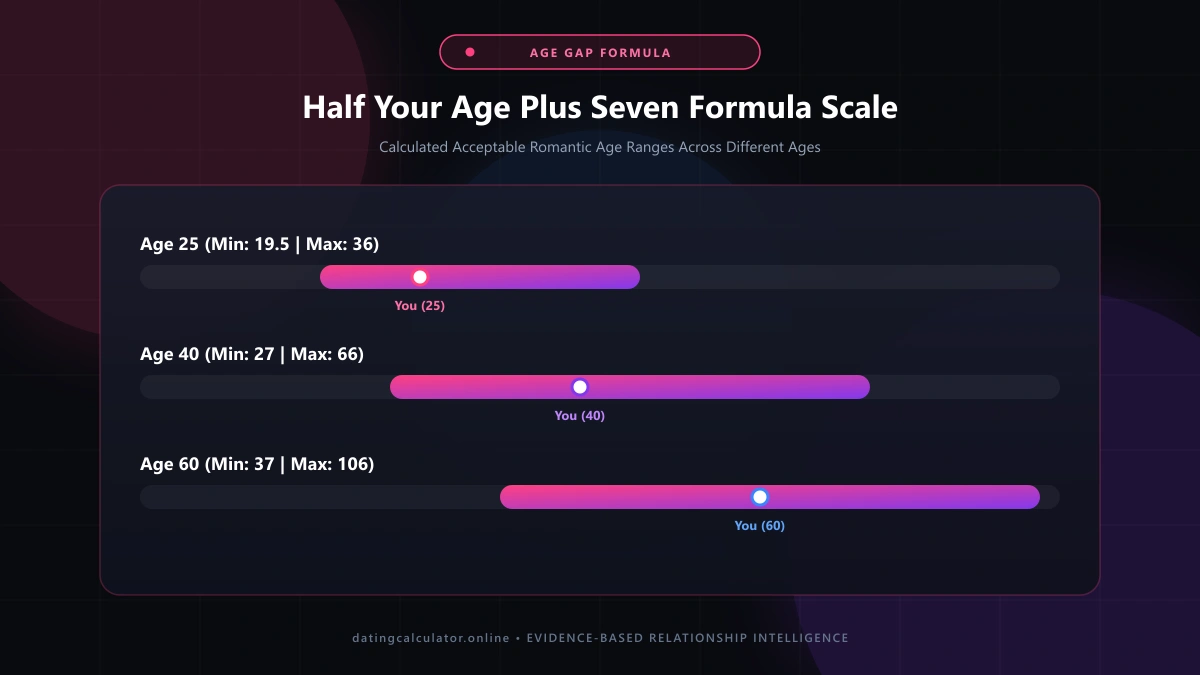
The dating age formula itself is straightforward: divide your age by two and add seven. A 40-year-old following the formula would get a minimum acceptable age of 27. The maximum age formula flips this around, subtracting seven from a partner’s age and then doubling it.
What This Method Is Actually Trying to Measure
At its core, the method tries to measure age appropriateness — a rough boundary meant to flag relationships where a significant power dynamics age gap might exist. It was never designed to measure emotional compatibility or shared values between two people.
How the Calculation Changes as You Get Older
As you age, the calculated dating age range widens considerably. A 25-year-old’s minimum partner age is close to their own, while a 60-year-old’s calculated minimum drops much further below their actual age, which critics call inconsistent.
Why This Method Is a Guideline, Not a Rule
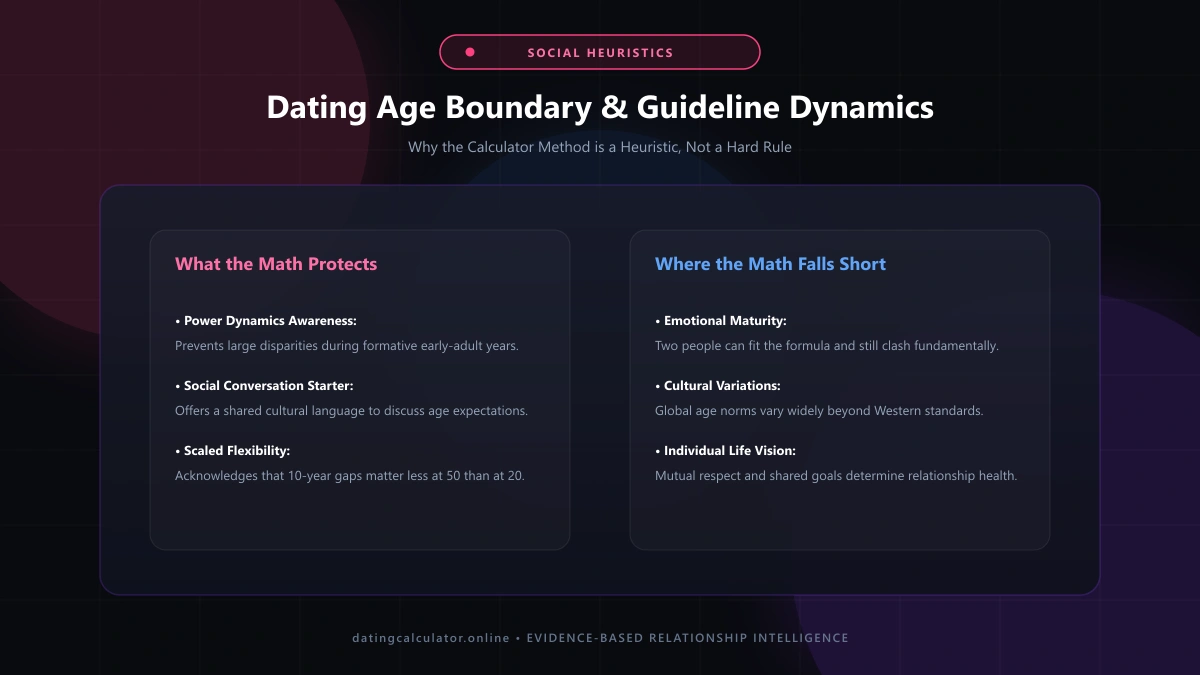
Despite how often it’s quoted, the formula was always meant as a loose age gap guideline, not a dating age rule to follow strictly. Treating it as law ignores individual maturity, circumstances, and the actual dynamics of a relationship.
Common Misunderstandings About the Formula
A common misunderstanding is assuming the formula sets a hard legal boundary. It doesn’t — it’s a social rule of thumb. Another mix-up is applying it only one direction, forgetting the maximum age formula exists for the older end too.
How Cultural Norms Influence the Numbers
Age gap social norms shift significantly between cultures and generations. What one community considers a comfortable relationship age gap might raise eyebrows elsewhere, meaning the formula’s output means very different things depending on where you live.
When the Formula Doesn’t Reflect Real Compatibility
Two people can fall neatly inside the formula’s range and still be a poor match, while others outside it build a genuinely strong relationship. Romantic partner age compatibility depends far more on communication and life stage than one number.
How This Method Compares to Other Dating Rules
Compared to other dating age benchmark rules, like fixed minimum-age laws or simple ‘stay within ten years’ advice, the half-your-age-plus-seven formula is more flexible but also more arbitrary, scaling unevenly as people get older.
Using the Formula as a Conversation Starter, Not a Verdict
The most practical use of the formula today is as a lighthearted conversation starter, not a serious decision-making tool for anyone. Plugging in your age and seeing the calculated result can spark a genuinely useful discussion about a real relationship age gap between two people.
Half Your Age Plus Seven — Example Results
| Your Age | Minimum Partner Age | Maximum Partner Age |
|---|---|---|
| 25 | 19.5 | 36 |
| 40 | 27 | 66 |
| 60 | 37 | 106 |
Conclusion
The calculator method in dating boils down to a simple formula — half your age plus seven — used to estimate a socially acceptable age gap. It’s a useful conversation starter, not a rule to follow strictly, since real compatibility depends on far more than a calculated number alone. Understanding where the dating age formula came from helps you use it the way it was originally intended: a rough guideline.